Why Government Chooses Ceiling GH
A ministry, an agency office, a courtroom or a public hall is a building the country owns and the public walks into. The ceiling in a ministerial reception, a council chamber or a registry hall carries a register of permanence — a heritage plaster cornice and a ceiling rose say the institution has been here and will stay. Ceiling GH has worked ceilings across Accra since 1973, and public buildings are a sector where the ceiling is part of how an institution presents itself, and part of how the building serves the people who use it every day.
Public work also runs on documentation and on value — a public budget is accounted for, and the ceiling has to be the right specification for the building rather than the most expensive one available. We design to the room — heritage plaster where the register demands it, acoustic ceilings where chambers and offices need speech to stay clear and private, durable serviceable grids where public traffic is heavy — and quote it honestly on survey so the spend is justifiable line by line.
What Government Ceilings Demand
Acoustics & Confidentiality
Council chambers, committee rooms and offices need speech to stay clear inside the room and not carry beyond it. An acoustic ceiling — a mineral-fibre suspended grid or a perforated-timber panel system — absorbs reflected sound so a chamber stays intelligible and an office stays private. In a public-facing hall, the same absorption keeps a busy space from becoming a wall of noise.
Heritage Register
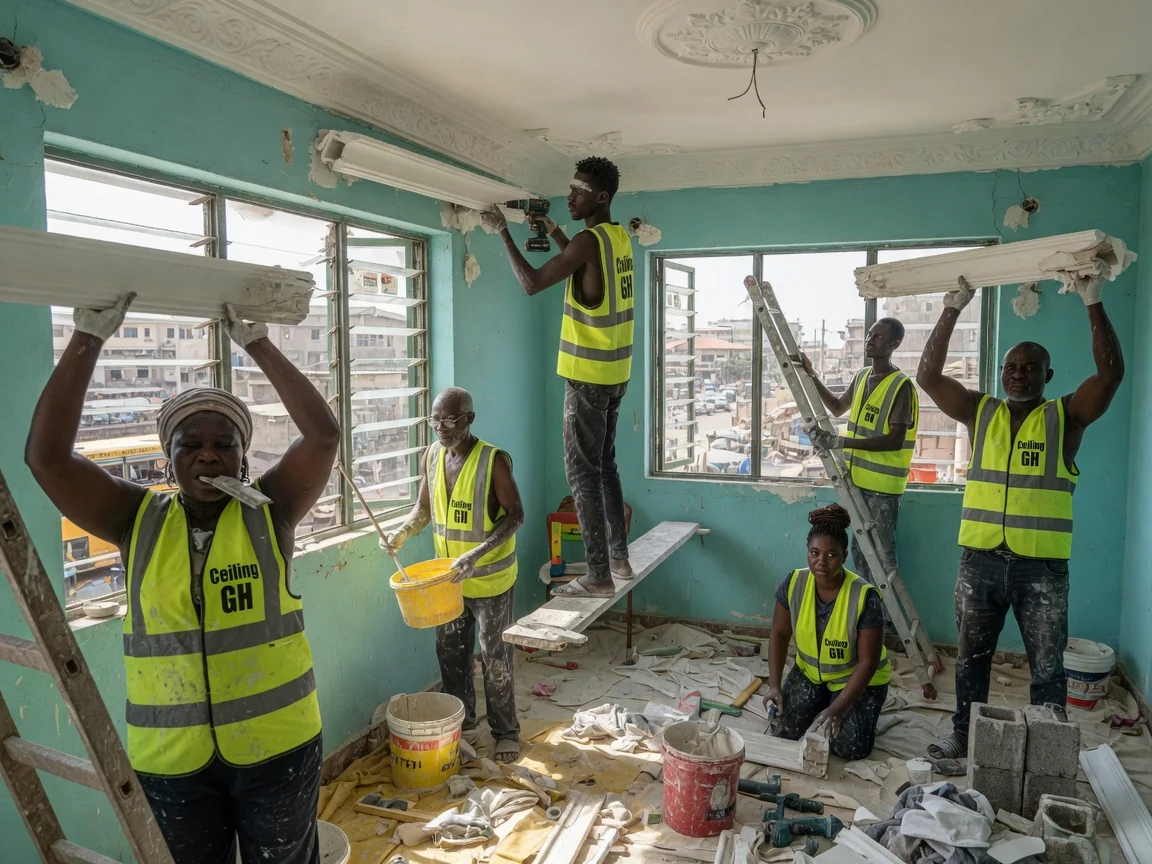
Older government and civic buildings carry plaster cornices, ceiling roses and coving from the original build. When a ceremonial wing is refurbished or a damaged run is made good, the new work has to match the original profile — heritage cornice restoration is profile-matching craft, not a stock moulding pushed up to fill a gap.
Services Access
Public buildings carry lighting, smoke detection, HVAC, PA and data. A suspended ceiling gives planned, demountable access to all of it, so maintenance and upgrades — frequent in a working public building — do not mean breaking out a finished ceiling.
Durability & Accountability
A public building runs for decades and its spending is audited. A correctly framed plaster ceiling and a properly fixed suspended grid both hold for the life of the building, and a clear specification quoted on survey is one that stands up to a value-for-money review.
Our Government Ceiling Scope
- Cornice & Heritage Ceilings — plaster cornices, ceiling roses, coving and heritage profile-matching for ceremonial and registry spaces
- Acoustic Ceiling Systems — sound-absorbing ceilings for chambers, committee rooms and offices
- Fire-Rated Suspended Ceilings — fire-rated suspended grids for corridors and public assembly spaces where required
- POP Design Ceilings — plaster ceilings and cove lighting for entrance halls and reception areas
- Ceiling Cost in Ghana (2026) — how ceiling cost is built up by type, area and height
Standards & Materials
Where a job uses gypsum or drywall board — for a flat modern ceiling or a suspended system — that board is specified to ASTM C1396 / EN 520, the recognised standards for gypsum panel products. Acoustic ceilings are specified by absorption performance: an NRC rating (noise reduction coefficient, tested to ISO 354) for how much sound a tile absorbs, and a CAC rating (ceiling attenuation class) for how well the ceiling blocks sound between adjacent rooms — the figure that matters for a chamber beside an office. Where a compartment requires fire performance, a Type X fire-rated board is specified to its tested rating, and only where it is genuinely required.
Plaster of Paris — POP, cornices and ceiling roses — is a craft finish, not a product with a standard: quality there comes from the frame, the span and the curing, worked by a skilled hand, not a certificate. We do not attach standards to plaster that do not exist, and we do not claim a fire or acoustic rating a material does not carry.
Government Ceilings Across Accra
Ceiling GH installs government and public-building ceilings across Greater Accra — Spintex, Adenta, Madina, East Legon, Achimota and Tema, with the ministries and civic district around Ridge and the city centre at the heart of this work — plus Kumasi and Takoradi. Cost is given on survey: the heritage, acoustic or fire requirement, the ceiling area and height, and access all move the figure, so the firm quote follows a site measure rather than a rate named before the room is seen — which is also how a public budget gets a number it can account for.